


Search any SMSF forum or accounting blog and you will find the same phrase repeated constantly, that property only needs a valuation every three years. This is true, but only in a specific and limited sense, and trustees who take it too literally often end up with an audit query they did not see coming.
This guide explains exactly what the three year rule means, what is required in the years between, and the specific events that override the cycle entirely regardless of when the last formal valuation was done.
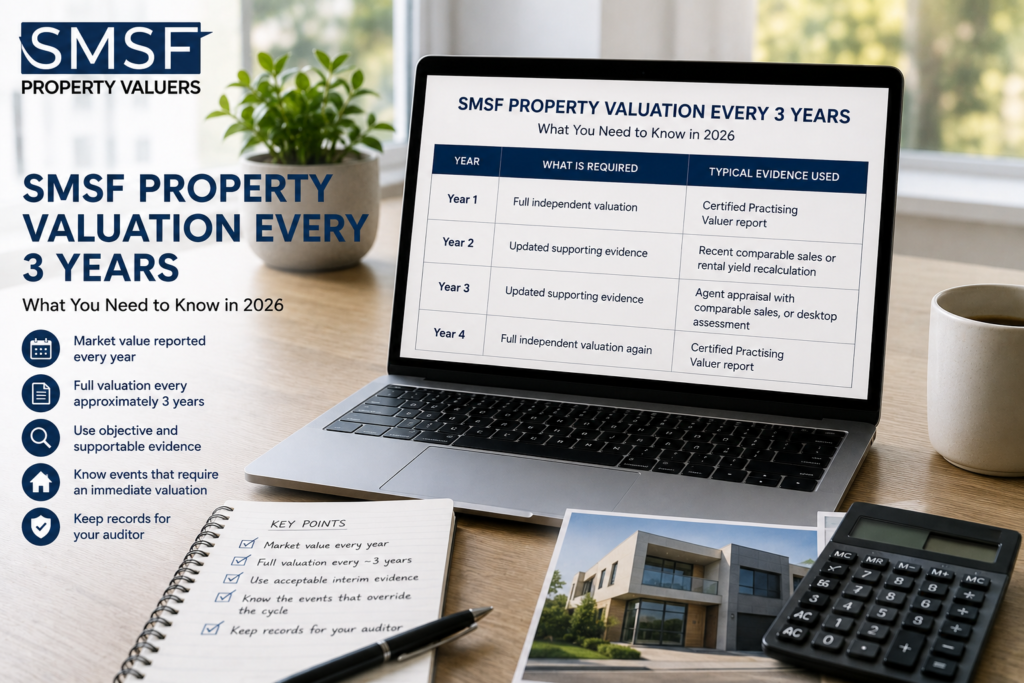
What the Three Year Rule Actually Says
The ATO requires SMSF property to be reported at market value every single year in the fund’s financial statements. The three year reference is general industry guidance about how often a full, formal valuation by a qualified valuer is expected. In the two years between full valuations, the fund still needs to report current market value, just using lighter supporting evidence rather than a complete professional report.
| Year | What Is Required | Typical Evidence Used |
| Year 1 | Full independent valuation | Certified Practising Valuer report |
| Year 2 | Updated supporting evidence | Recent comparable sales or rental yield recalculation |
| Year 3 | Updated supporting evidence | Agent appraisal with comparable sales, or desktop assessment |
| Year 4 | Full independent valuation again | Certified Practising Valuer report |
What Counts as Acceptable Evidence in the Interim Years
The acid test most auditors apply is simple. Would the evidence on file reasonably satisfy an independent reviewer that the 30 June figure reflects genuine market value. Several types of evidence can clear that bar for straightforward residential property, though commercial and related party situations require a higher standard.
| Acceptable Interim Year Evidence | When It Works Best |
| Recalculating rent against the last independent yield | Commercial property with a stable lease in place |
| Recent comparable sales in the same area | Residential property in an active local market |
| Written agent appraisal listing comparable sales | Straightforward residential property, low risk |
| Council rate notice value | Residential only, never sufficient alone for commercial or rural |
People Also Ask: How often should investment property be valued? Outside an SMSF, there is no fixed legal requirement, though most owners and lenders review value every one to three years, or whenever a major life event such as refinancing, sale, or estate planning makes a current figure necessary. Inside an SMSF, the ATO’s expectation is more structured, requiring annual reporting with a full valuation roughly every three years.
Why Many Trustees Get This Rule Wrong
The most common mistake is treating the three year cycle as a fixed countdown that applies no matter what happens to the property or the fund in between. In reality, several events override the cycle completely and require an immediate fresh valuation, even if the last full report was completed only twelve months ago.
| Events That Override the Three Year Cycle |
| The SMSF acquires or disposes of the property in a related party transactionA member commences a pension and the transfer balance cap depends on the property valueThe property undergoes a significant renovation or redevelopmentLocal market conditions shift materially, such as a sudden price movement in the areaThe property changes use, for example from residential to commercial tenancyYour auditor specifically requests updated evidence due to a concern raised in a prior year. |
| Real Scenario |
| A self managed fund in regional New South Wales held a commercial property leased to a related party business. The trustees had a full valuation completed in year one and assumed they were covered until year four under the standard cycle. In year two, the lease terms changed when the related party renegotiated rent downward. Because this was a related party transaction affecting value, the auditor required fresh independent evidence immediately, well ahead of the planned year four review. The trustees who understand that related party events override the standard timing avoid this kind of mid cycle surprise. |
How This Differs for Commercial Property
Commercial property held in an SMSF, particularly where it is leased back to a related business, faces closer scrutiny than residential property. Rental yield recalculations can serve as interim evidence, but only where the lease terms and market rent have not changed materially since the last full valuation. Any change to the lease, the tenant, or the rent itself effectively resets the clock and warrants a fresh look at the figure being reported.
Common Property Rules of Thumb and Where They Do Not Apply
Several popular investing rules of thumb get mentioned alongside SMSF property discussions, but most of them are general investment screening tools rather than compliance requirements. It helps to know the difference so they are not mistaken for an ATO rule.
| Rule | What It Means | Relevance to SMSF Property |
| 2 percent rule | Weekly rent should equal roughly 2 percent of the purchase price for a strong cash flow investment | A general investment screening tool, not an ATO or SIS valuation method |
| 3 5 7 rule | A property investing guideline suggesting target annual growth rates over 3, 5 and 7 year periods | Used in investment strategy discussions, has no role in SMSF compliance valuation |
| 5 percent in house asset rule | SMSF in house assets, including certain related party investments, generally cannot exceed 5 percent of total fund assets | Directly relevant, since an undervalued or overvalued property can distort this calculation |
People Also Ask: What is the SMSF 6 month rule? There is no specific SMSF property valuation rule officially called the 6 month rule. This phrase is sometimes used informally to refer to timeframes for resolving in house asset breaches or correcting compliance issues once identified, which generally must be addressed within a reasonable period, often discussed as around six months, though the exact timeframe depends on the specific breach and ATO guidance at the time.
People Also Ask: What is the 5 rule for SMSF? The 5 rule generally refers to the in house asset rule, which limits in house assets, including certain related party investments and loans, to no more than 5 percent of the total market value of the fund’s assets. An inaccurate property valuation can distort this percentage and create a compliance breach without the trustees realising it.
People Also Ask: What is the 3-5-7 rule in investing? The 3 5 7 rule is a general property investment guideline rather than an SMSF compliance rule. It suggests that property values might reasonably be expected to grow by certain percentages over 3, 5 and 7 year periods as a rough planning benchmark. It has no bearing on how the ATO requires SMSF property to be valued for compliance purposes.
People Also Ask: What is the 2% rule for properties? The 2 percent rule is an investment screening guideline suggesting that weekly rental income should equal around 2 percent of the property’s purchase price for a strongly cash flow positive investment. It is a useful filter when assessing a potential purchase but is unrelated to the ATO’s market value reporting requirements for an SMSF.
What This Means for Your Next Audit
If you are unsure where your fund sits in the cycle, the simplest starting point is to check the date of the last full independent valuation and compare it against any of the trigger events listed above. If more than three years has passed, or if a trigger event has occurred regardless of timing, a fresh valuation is the safer and ultimately cheaper option compared to resolving an audit query after the fact.
Conclusion
The three year rule is a genuine and useful guideline, but it is not a free pass to ignore property value for thirty six months at a time. Annual reporting is still required, lighter evidence is acceptable in the interim years, and several specific events override the cycle entirely. Understanding the difference between the general rule and its exceptions is what keeps a fund consistently audit ready rather than scrambling before a deadline.
| Due for Your SMSF Property Valuation SMSF Property Valuers Australia provides ATO compliant, API and AVI accredited valuation reports for residential and commercial SMSF property across every state and territory. Fixed fee pricing, fast turnaround, audit ready reports. Request your free quote today. |
Frequently Asked Questions
Does the three year rule mean I only think about valuation once every three years?
No. Market value must still be reported every year. The three year reference relates to how often a full, formal valuation by a qualified valuer is expected, with lighter evidence acceptable in the interim years.
What happens if a related party transaction occurs in an interim year?
A related party acquisition or disposal requires an independent valuation at the date of the transaction regardless of where the fund sits in its normal three year cycle. This event overrides the standard timing entirely.
Can rental yield alone be used as interim evidence for commercial property?
Yes, provided the lease terms and market rent have not changed since the last full valuation. If the rent or tenant changes, this method is no longer reliable and a fresh look at the value is needed.
Is a council rate notice sufficient evidence for any property type?
A council rate notice can support residential property in an interim year but is not sufficient on its own for commercial or rural property, where more detailed evidence is expected.
What should I do if I am not sure when the last full valuation was completed?
Check your fund’s records and previous financial statements for the date and source of the last formal report. If it has been more than three years, or if any trigger event has occurred since, commission a fresh independent valuation before your next audit.
Does starting a pension always require a brand new valuation?
In most cases yes, particularly where the property value materially affects the transfer balance cap calculation. Using an outdated or informal figure at this point creates a compliance risk that can affect the member’s pension account for years.
How long should valuation evidence be kept on file?
Valuation reports and supporting evidence should be retained for at least ten years to meet ongoing superannuation record keeping and audit requirements.
Is this three year guidance the same in every state of Australia?
Yes. The ATO requirement and the three year industry guidance apply nationally. There is no difference in the underlying rule between New South Wales, Victoria, Queensland, Western Australia, South Australia, or any other state or territory.