


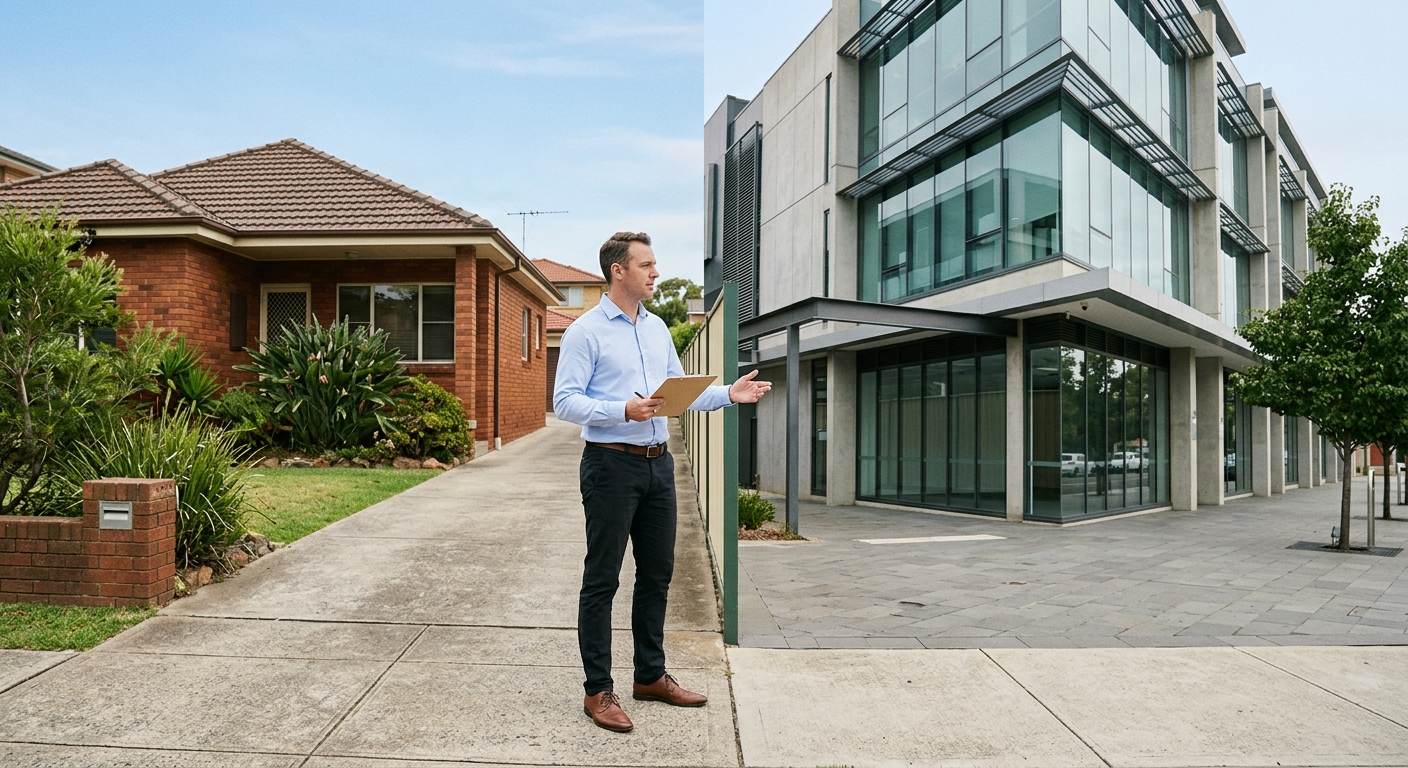
If you’ve been weighing up whether your self-managed super fund should buy a house, a unit, or the warehouse your business operates from, you’re not alone. It’s one of the most common questions SMSF trustees ask their accountant, financial adviser or valuer — and the honest answer is “it depends,” because residential and commercial property sit under quite different rules once they’re inside super.
This matters more than it used to. Following the Treasury Laws Amendment (Tax Reform No. 1) Act 2026, which received Royal Assent on 26 June 2026, the borrowing rules for residential property inside an SMSF changed from 10 August 2026. That doesn’t mean SMSFs can no longer own residential property — it means the pathway to buying it has narrowed, and trustees need to understand exactly where the new lines sit before signing a contract.
This SMSF property investment guide walks through what’s actually different between residential and commercial property inside super, including the different SMSF property types trustees can consider, what the borrowing rules do and don’t cover, and the compliance traps — related-party rules, the sole purpose test, and market value requirements — that catch trustees out most often.
Summary: What You Need to Know
An SMSF can still hold both residential and commercial property, but the practical pathways differ sharply. Commercial property that meets the “business real property” definition can be bought from a related party (such as a member’s own business), leased back to that business at market rent, and — this is the key point post-August 2026 — can still be purchased using a limited recourse borrowing arrangement (LRBA). Residential property cannot generally be acquired from a related party under any circumstances, cannot be lived in or rented to a member or their relatives, and — since 10 August 2026 — can no longer be bought using a new LRBA. It can still be bought outright with the fund’s existing cash, contributions or rollovers.
The key factors trustees need to weigh up are: whether the fund has enough liquidity to buy outright (if residential), whether a related-party purchase is even possible (usually only relevant for commercial), how the sole purpose test and in-house asset rules apply, and how rental income and eventual capital gains will be taxed inside the fund compared to holding the same property personally. Before committing, get independent advice from an SMSF specialist and, where a related party is involved or a bank is lending against the property, an independent market valuation to demonstrate the price and rent are at arm’s length.
SMSF Property Investment Guide: Residential vs Commercial at a Glance
Before getting into the detail, it helps to see the two options side by side. Both residential and commercial property purchases inside an SMSF are governed by the Superannuation Industry (Supervision) Act 1993 (the SIS Act) and regulated by the Australian Taxation Office (ATO) — but the SIS Act treats them quite differently.
| Residential Property | Commercial Property (Business Real Property) | |
| Buy from a related party (e.g. a member) | Generally prohibited | Allowed, at market value, if used wholly and exclusively in a business |
| Lease to a fund member or their business | Not allowed under any circumstances | Allowed, at market rent, if it qualifies as business real property |
| Borrow to buy (new LRBA) from 10 August 2026 | No longer available for new arrangements | Still available |
| Buy outright with fund cash | Allowed | Allowed |
| Typical buyer | Trustees diversifying into housing, granny flats, units | Business owners buying their own premises |
A quick note on terminology: “business real property” (often shortened to BRP) is a specific legal term under section 66 of the SIS Act, not just a synonym for “commercial property.” It means land or a building used wholly and exclusively in one or more businesses — regardless of whether that building looks like a shop, warehouse, office, or even, in rare cases, a house. A doctor’s surgery run out of a converted residential property can qualify as business real property; a rented-out residential investment property never does, because renting property to tenants isn’t “carrying on a business” in the sense the SIS Act requires.
The Related-Party Rule: Where Residential and Commercial Really Diverge
Section 66 of the SIS Act generally stops an SMSF acquiring assets from a “related party” — which includes fund members, their relatives, and companies or trusts they control, subject to the SMSF investment restrictions on acquiring assets from related parties. This is the single biggest practical difference between residential and commercial property inside super.
Residential property: if a member (or their spouse, parent, sibling, or child) owns an investment property or their family home, the SMSF cannot buy it from them, full stop. There’s no market-value workaround. This trips up a surprising number of trustees who assume that as long as they pay a “fair price,” an in-specie transfer of their own rental property into their fund is fine. It isn’t.
Commercial property that qualifies as business real property: this is one of the few carve-outs to section 66. If a member owns, say, the retail shop or industrial unit their business trades from, the SMSF can buy that property from them — provided it happens at genuine market value, on arm’s length terms, and the property continues to be used wholly and exclusively in the business. This is why buying your own business premises is consistently one of the most popular SMSF property strategies: the fund becomes your landlord, you pay it market rent, and that rent — rather than going to an unrelated landlord — builds your retirement savings inside a concessionally taxed structure.
Getting the market value wrong on either side of a related-party transaction is a common and expensive mistake. An independent valuation, prepared by a qualified valuer rather than a real estate agent’s appraisal, gives trustees and their auditor something defensible if the ATO ever asks how the purchase or lease price was determined.
The Sole Purpose Test and Why You Can’t Live in SMSF Property
Section 62 of the SIS Act sets out the “sole purpose test” — the fund must be maintained for the sole purpose of providing retirement benefits to members (or their dependants if a member dies). This is the rule that stops a member or their relatives living in, holidaying in, or otherwise personally using residential property owned by their own SMSF, even if they pay market rent. It doesn’t matter whether it’s the family home, a holiday house at the coast, or a unit a member’s adult child wants to rent — if a related party occupies it, the fund almost certainly breaches both the sole purpose test and the related-party rules.
Commercial property is different precisely because a member’s business occupying the premises and paying rent is the whole point of the strategy, not a breach of it — provided the arrangement is genuinely arm’s length and properly documented with a lease.
Borrowing to Buy Property: What Changed from 10 August 2026
For years, one of the most talked-about SMSF strategies was using a limited recourse borrowing arrangement (LRBA) to buy an investment property — commercial or residential — with the fund borrowing part of the purchase price through a separate holding (bare) trust structure. That’s still available for commercial property, but it’s now closed off for new residential purchases.
Following the 2026 amendment, from 10 August 2026 an SMSF can only enter a new LRBA to acquire real property if that property meets the business real property definition. In practical terms:
- Existing residential LRBAs are unaffected. If your fund already had a residential property loan in place before commencement, nothing changes — you can keep servicing it, and in most cases refinance it, without breaching the new rules.
- Contracts exchanged before 10 August 2026 are grandfathered, even if settlement or the loan itself is finalised afterwards. This is why many trustees who were partway through a residential purchase rushed to get contracts unconditional before that date.
- New residential LRBAs entered into on or after 10 August 2026 are no longer permitted. A fund can still buy residential property outright — using existing cash, member contributions, or rollovers — just not by borrowing against it through a new arrangement.
- Commercial and business real property LRBAs are unaffected and remain one of the more common ways business owners fund the purchase of their own premises through super.
This is a fast-moving area, so if you’re mid-transaction or considering refinancing an existing residential LRBA, it’s worth getting current advice from an SMSF specialist accountant or adviser rather than relying on general information — including this article — for the final word on your specific situation.
Tax Treatment: How Rental Income and Capital Gains Are Taxed
One of the reasons property inside an SMSF remains attractive, even with the borrowing rules narrowed, is the tax treatment. Rental income earned by the fund is generally taxed at the concessional 15% rate that applies during the accumulation phase — well below most individuals’ marginal tax rate if they held the same property personally. Once a member moves into the retirement (pension) phase and the property supports an account-based pension, rental income attributable to that pension can become exempt from tax under the exempt current pension income rules, subject to the fund meeting the relevant conditions.
Capital gains are treated similarly: assets held for more than 12 months in the accumulation phase generally qualify for a one-third CGT discount (effectively a 10% rate on the gain), and again, gains realised once the asset is fully supporting a pension can be exempt.
There’s a catch worth flagging: if a related-party lease isn’t on genuinely commercial, arm’s length terms — for example, rent is set below market to help out a family member’s business — the ATO can treat that income as “non-arm’s length income” (NALI), which is taxed at the top marginal rate of 45% rather than the concessional rates above. This is another reason a properly documented, market-rate lease and an independent valuation matter for commercial property held in an SMSF.
Practical Considerations Before You Buy
Liquidity and the in-house asset test. SMSFs must generally keep no more than 5% of the fund’s assets in “in-house assets” (broadly, loans to or investments in related parties, and property leased to a related party that isn’t business real property). Because business real property is specifically excluded from this cap, a fund can lease 100% of its assets to a related business — something that wouldn’t be possible with most other related-party arrangements.
Diversification. A single property, whether residential or commercial, can end up being the fund’s largest asset by a wide margin. Trustees are required to record and regularly review an investment strategy that considers diversification, liquidity and the ability to pay member benefits (including lump sums) as members retire — a single illiquid property can make that difficult if a member needs to access their super sooner than planned.
Vacancy risk. Commercial property, especially where the sole tenant is the member’s own business, carries concentration risk: if the business struggles, the fund’s rental income (and the business’s ability to pay market rent) is affected at the same time. Residential property generally has a broader tenant pool but can still sit vacant between leases.
Ongoing costs. Both property types come with council rates, insurance, repairs, and — where an LRBA is in place — loan servicing costs that must be paid from the fund, not personally by a member.
Stamp duty and state variations. Transfer (stamp) duty applies to most SMSF property purchases and varies by state and territory, with some jurisdictions applying different rates or concessions depending on the buyer entity and property type. This is a state-based cost that should be factored into the numbers before signing a contract, and it’s worth checking current rates with your state revenue office or conveyancer, since they do change.
Common Misconceptions
- “I can transfer my rental property into my SMSF because I’m paying a fair price.” No — residential property can’t be acquired from a related party regardless of price.
- “My SMSF can rent the investment property to my adult child.” No — this breaches the related-party and sole purpose rules in the same way as a member living there.
- “The borrowing changes mean SMSFs can’t own houses anymore.” Not true — funds can still buy residential property outright, and existing residential loans are grandfathered. What’s closed is new borrowing for new residential purchases.
- “Any property my business uses counts as business real property.” Not automatically — it has to be used wholly and exclusively in a business, as tested under ATO ruling SMSFR 2009/1. Mixed residential and business use (beyond a very minor exception for some primary production land) can disqualify a property.
Frequently Asked Questions
Can my SMSF buy a house I already own personally?
No. Residential property can’t be acquired by an SMSF from a related party — including a fund member — regardless of the price paid or how the transaction is structured.
Can my SMSF still borrow to buy an investment property?
For business real property (broadly, commercial premises used wholly in a business), yes. For residential property, new borrowing arrangements entered into from 10 August 2026 are no longer permitted, though existing residential loans are grandfathered.
Is a granny flat or dual-key property treated as residential or commercial?
It’s assessed on how it’s actually used. A self-contained residential dwelling is residential property for SMSF purposes, even if it’s a secondary structure on a larger block, unless the whole site genuinely operates as a business (such as a licensed short-stay accommodation business), which is a higher bar than most trustees expect.
Do I need a valuation every year for SMSF property?
Yes. SMSF trustees are required to value fund assets, including property, at market value each year for the fund’s financial statements and audit, and maintaining appropriate SMSF property valuation evidence can help support the reported value. , and an independent valuation is typically expected where a related party is involved in the purchase or lease, or where the fund’s auditor has concerns about the basis for the reported value.
Can my SMSF buy commercial property with other investors, including family members?
Yes, joint ownership (such as tenants in common) is possible, but the arrangement must be genuinely arm’s length, properly documented, and the related-party rules still apply to whichever share is acquired from a related party.
What happens if my SMSF accidentally breaches the property rules?
The ATO can declare the fund non-complying, which can result in the fund’s assets being taxed at up to 45%, along with administrative penalties and, in serious cases, disqualification of individual trustees. Rectifying a breach early and disclosing it, with professional advice, generally leads to a better outcome than letting it continue.
Conclusion
Residential and commercial property sit under genuinely different SMSF rules — not just different investment profiles. Commercial property offers more flexibility around related-party purchases, leasing to a member’s business, and borrowing; residential property is more restricted, especially since new LRBAs closed from 10 August 2026. Whichever path you’re considering, get advice tailored to your fund and an independent valuation before you sign anything.
If you’re weighing up a residential or commercial property purchase through your SMSF, an independent, ATO-compliant valuation gives your trustees and auditor a clear, defensible record of market value — particularly important for related-party transactions and annual reporting. SMSF Property Valuers prepares valuation reports across residential, commercial and specialised property classes for SMSF trustees Australia-wide. You can reach the team on +61 438 080 786 to discuss what’s needed for your situation.